.png)





The Stories That Still Haunt Australia’s Past-Australian historical fiction novels

Updated: Jul 20
By Amanda Smith
Australian historical fiction novels do more than recreate the past. At their best, they explore the human cost of history—the ordinary lives shaped by migration, conflict, isolation, and the search for belonging. It is not simply about placing characters within a past setting, but about exploring how lives are shaped—often quietly, sometimes irreversibly—by forces beyond individual control.
In many ways, Australian historical fiction sits at the intersection of land, identity, and memory. It asks not only what happened, but what it meant for the people who lived through it—and what continues to echo forward.

What Makes Australian Historical Fiction Distinct
Unlike many historical traditions, Australian historical fiction is often grounded in lived experience shaped by distance, migration, and cultural tension.
Recurring themes include:
The experience of arrival and displacement
The challenge of belonging in unfamiliar or contested spaces
The enduring impact of colonial systems
The relationship between people and landscape
These are not simply narrative backdrops. They form the conditions under which characters make decisions, form relationships, and attempt to understand who they are.
The idea of men arriving with hope, only to be reshaped by forces they don’t understand, sits at the heart of Outback Odyssey—a story shaped as much by the land as the people within it.

Notable Australian Historical Fiction Novels
Many of the most influential Australian historical fiction novels focus on individuals navigating forces far greater than themselves.
A number of writers have approached these themes from different angles, offering distinct but complementary perspectives.
Kate Grenville explores the complexities of early colonial settlement, particularly in The Secret River, where personal ambition intersects with cultural conflict.
Geraldine Brooks often focuses on moral and historical dilemmas, as seen in Year of Wonders, examining community, belief, and survival under pressure.
Peter Carey brings a layered, often unconventional perspective to Australian history, notably in True History of the Kelly Gang, where voice and identity are central to the narrative experience.
Each of these works reflects a different facet of Australian history, yet all share a concern with how individuals navigate systems far larger than themselves.
A Contemporary Perspective
More recent contributions to the genre continue this tradition, often focusing on quieter, more internalised forms of conflict.

One such example is Outback Odyssey by Paul Rushworth-Brown. Set in post-war Australia, the novel follows Jimmy Brown, a young Yorkshire migrant whose search for a better life becomes something far more profound. As he confronts the harsh realities of the Australian outback, he discovers that survival is not simply about endurance, but about allowing himself to be changed by the land, the people, and a way of seeing the world he never expected.
Beneath its historical setting, however, Outback Odyssey also works as an allegory (a story that says one thing on the surface but means something deeper underneath). Jimmy's journey becomes one of transformation as he learns that survival is about more than adapting to a new country. Through the quiet wisdom of the First Nations people who guide him, he comes to understand that the land is not something to conquer, but something to respect. Their knowledge of Country reshapes not only the way he survives, but the person he becomes.
While each of these novels approaches Australian history from a different perspective, Outback Odyssey shares the belief that history is best understood through the lives of ordinary people. Rather than retelling famous events, it explores how identity is transformed through hardship, belonging is earned rather than given, and the wisdom of First Nations people reveals a deeper relationship between humanity and Country. History provides the setting, but the journey is ultimately one of personal transformation.
Why These Stories Continue to Matter
What connects these works is not simply their setting, but their focus.
They are not driven by spectacle, but by consequence.
They remind us that history is not only made by leaders or defined by major events. The—often without full understanding of the forces acting upon them.
In this way, historical fiction becomes less about looking back, and more about recognising patterns that continue to shape the present.
A Final Reflection
Australian historical fiction offers something distinct: a space where landscape, memory, and identity converge.
It invites readers to consider not just what happened, but what it meant to endure it—and what it might mean still.
Stories like these are not simply about the past. They are about the human experience within it.
Others force us to confront the voices history tried to leave outside the room.
Discover the real story behind Outback Odyssey. Explore the historical research, authentic Australian landscapes, First Nations influences, and true events that inspired Paul Rushworth-Brown's award-winning novel.
Watch more long-form author conversations exploring history, memory, power, and the lives often overlooked by official narratives.
__________________________________________________________________________________

Paul Rushworth-Brown is the author of five novels:

The Thomas Rushworth Chronicles
History remembers the great events. The Thomas Rushworth Chronicles remembers the people who lived through them.
Set in Yorkshire between 1590 and 1603, these free serialized chronicles follow ordinary men and women navigating a world shaped by plague, poverty, manor courts, religious tension, crime, punishment, and survival. Here, history is not a distant backdrop but a force that shapes every decision, every relationship, and every life.
At the centre of the story are the Rushworth family and the villagers around them—labourers, servants, tavern keepers, stewards, merchants, soldiers, widows, outcasts, and those living on society's margins. Some seek opportunity. Some seek justice. Others are simply trying to survive.
Each Chronicle reveals another piece of a larger world filled with hidden motives, dangerous loyalties, village secrets, manor politics, and the everyday struggles of ordinary people trapped inside forces far greater than themselves.
Published as an ongoing serial, The Thomas Rushworth Chronicles invites readers to step into the lives history often ignored and experience the human cost of living through the past.
History continues...
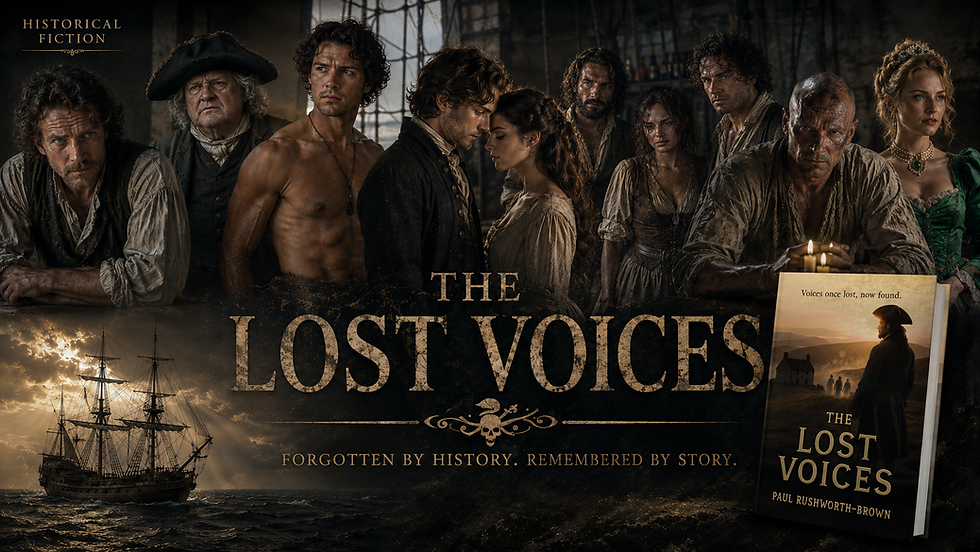
Some lives disappear into history. Others refuse to remain buried.
In the shadow of industrial Yorkshire, two brothers leave the moors behind in search of opportunity, survival, and a future larger than the lives they were born into. But the growing streets of Leeds offer no easy promises. Beneath the smoke, ambition, and expanding wealth lies a world shaped by hardship, silence, class division, and the quiet cost of survival.
As old loyalties fracture and hidden tensions rise, the Rushworth brothers are forced to confront a difficult truth: history is not only shaped by kings and power—but by ordinary people trying to endure the forces closing around them.
The Lost Voices is a richly atmospheric historical novel about identity, endurance, family, and the human cost of history.

He came to Australia with hope. The land had other plans.
In 1950s Australia, a young Yorkshireman arrives under the Big Brother Movement scheme believing hard work and opportunity will give him a better life. Instead, he enters a harsh and unfamiliar world shaped by silence, isolation, power, and histories far older than his own.
Far from the promises he was sold, Jimmy is forced to navigate the brutal realities of outback station life, cultural tension, survival, and the uneasy relationship between belonging and identity. But as he forms unexpected connections with Aboriginal stockmen and begins confronting the truths beneath Australia’s surface, the land itself starts changing him in ways he never expected.
Outback Odyssey is a powerful historical novel about ordinary people caught inside forces far greater than themselves — and the human cost of surviving them.
Find out more: https://www.paulrushworthbrown.com/books

Yorkshire, 1590.On the windswept moors, survival often depends on silence, suspicion, and knowing who to trust before darkness falls.
When rumours begin spreading through the villages and hidden tensions rise beneath the surface of ordinary life, young Thomas Rushworth is drawn into a dangerous world of deception, violence, secret loyalties, and mysteries that refuse to stay buried. Beyond the manor walls and muddy roads lies a brutal existence where peasants struggle to survive against hunger, fear, class division, and the constant threat of ruin.
But in Yorkshire, danger rarely announces itself openly.
Skulduggery is a gritty and atmospheric historical mystery that pulls no punches in its portrayal of life on the Yorkshire moors. Rich in historical realism, suspense, hidden motives, and emotional tension, it immerses readers in a world where every choice carries consequences — and ordinary people are often trapped inside forces far greater than themselves.
Perfect for readers who love historical suspense, medieval intrigue, atmospheric mysteries, and emotionally immersive fiction.
“I intended to read it over the next week but once I started I could NOT put it down.”

England, 1642.Civil war is coming — and ordinary families will pay the price.
As violence spreads across the Yorkshire countryside and neighbour turns against neighbour, the Rushworth family find themselves trapped inside a conflict far greater than they ever imagined. What begins as a struggle for survival soon becomes a dangerous journey through fear, divided loyalties, betrayal, and the brutal realities of a nation tearing itself apart.
Across frozen landscapes, war-torn villages, and uncertain roads, the family must navigate hardship, loss, hidden dangers, and the fragile hope that love and loyalty can survive even in the darkest of times.
But history rarely spares ordinary people.
Red Winter Journey is a richly atmospheric historical adventure filled with suspense, emotional depth, humour, intrigue, romance, and the harsh realities of the English Civil War. Twisting and turning until the very end, it is a story about endurance, family, and the human cost of history itself.
Perfect for readers who love immersive historical fiction, gripping adventure, emotional storytelling, and unforgettable journeys through the past.
“A fictional, historical novel about a loving peasant family caught up in a shocking Civil War. Humour, romance, adventure and excitement are here to enjoy. A great story.”

England, after the execution of King Charles I. The monarchy is gone. Fear rules the roads. And survival belongs to those willing to risk everything.
As Oliver Cromwell’s new Republic tightens its grip across England, the Rushworth family struggle to escape poverty in a country shaped by suspicion, violence, and uncertainty. Along dangerous highways and through shadowed taverns, they encounter highwaymen, thief-takers, pirates, smugglers, and the brutal underworld hidden beneath England’s fragile new order.
But every opportunity comes at a cost.
Drawn into a world of deception, shifting loyalties, hidden motives, and deadly secrets, the family soon discover that survival in this new England demands more than courage alone. Because in a land where power changes hands overnight, trust can become the most dangerous gamble of all.
Dream of Courage is a gripping historical thriller filled with mystery, suspense, danger, adventure, and emotional intensity. Rich in atmosphere and historical realism, it continues the sweeping story of ordinary people trying to endure the forces of history closing around them.
Perfect for readers who love historical suspense, dark adventure, gritty realism, and immersive journeys through England’s turbulent past.


Historical fiction has the power to do more than entertain—it can encourage us to reflect on our shared history, identity, and the experiences that have shaped our communities.
Following Paul Rushworth-Brown's recent nomination for Impact Books Author of the Year, I wrote this feature for the CB Herald exploring why Outback Odyssey has resonated with readers and sparked conversations about Australia's history, migration, belonging, and our shared future.
Read the original CB Herald feature:
https://bit.ly/4exAIpG
Amanda, this is a beautifully considered piece.
What stands out is the way you’ve framed Australian historical fiction not as something driven by events, but by consequence. That distinction matters—and it’s often where the deeper understanding begins.
The idea that landscape, memory, and identity are not separate elements, but forces acting on individuals, is something readers are increasingly recognising for themselves.
When a story allows that space for reflection, it tends to stay with people long after they’ve finished it.
Thoughtful work like this helps bring that into clearer focus.