.png)






Historical Context Companion -Red Winter Journey

This companion sits alongside Red Winter Journey, offering historical context to the world in which the novel is set.

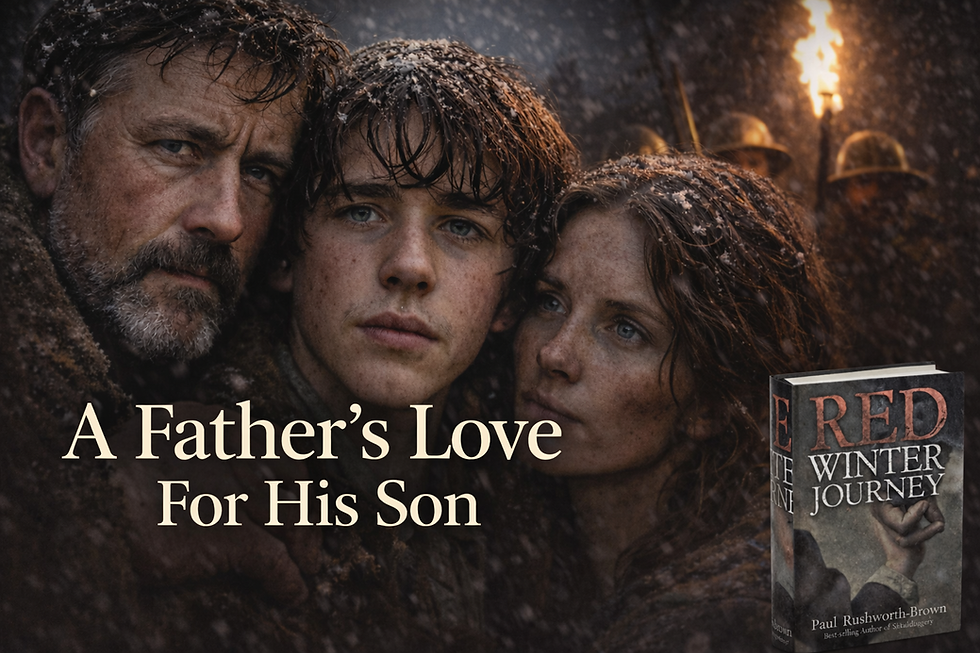
The English Civil Wars (1642–1651) were not only fought on battlefields—they reshaped everyday life, displacing families, destroying livelihoods, and forcing ordinary people into impossible choices.

The following plates explore that reality.
Before Everything Changes

Before the outbreak of the English Civil War in 1642, daily life for most people was shaped by routine—family, work, and local community.
For many, the conflict did not begin with open battle, but with disruption: the arrival of soldiers, the taking of goods, and a growing uncertainty about authority and allegiance.
What had once been stable and familiar could change quickly, often without warning.
This was the point at which private lives began to be shaped by public conflict.
When War Arrives
During the English Civil Wars, both Royalist and Parliamentary forces relied heavily on impressment—the forced recruitment of men and boys into military service.
Those taken were often young and physically able, not because they were expendable, but because they were seen as adaptable and capable of enduring the demands of campaign life. In many cases, individuals had little choice in the matter. Refusal could bring punishment, and shifting loyalties were common, especially among prisoners who were compelled to serve the opposing side.
For ordinary people, war did not arrive as a distant political conflict—it entered homes, taverns, and roadsides, where authority could be asserted without warning.
A Land Turned Against Its People

The English Civil Wars affected far more than those who fought. Across regions such as northern Yorkshire, communities were repeatedly exposed to troop movements, requisitioning, and violence, placing sustained pressure on already fragile rural economies.
Life expectancy in the 17th century was shaped by high infant and child mortality. Many children did not survive beyond early childhood, and families were acutely aware of the uncertainty of survival. In this context, the protection of children—particularly sons, who might inherit land, labour, or family responsibility—carried both practical and emotional weight.
The disruption of war often fractured households. Men could be taken into service with little warning, and in some cases, wives and families followed armies or moved alongside them, navigating insecurity, displacement, and dependence on military structures for survival.
For many, the conflict was not defined by allegiance, but by the effort to endure it.
What Remains

Armies operating in the field were frequently undersupplied, particularly in clothing and equipment. New recruits—whether volunteers or those taken into service—were rarely issued fresh garments. Instead, clothing was often taken from the dead or from those no longer able to march.
These items were worn again out of necessity, sometimes still bearing the marks of previous use—mud, damage, and decay. In prolonged campaigns, hygiene was minimal, and garments could quickly become a source of discomfort and disease.
Such practices were not unusual, but reflective of the wider conditions of the war: scarcity, movement, and the constant need to sustain forces with limited resources. For many, even the clothes they wore were a reminder of how easily one life could be replaced by another.
Moral Collapse

The English Civil Wars were fought not only by organised forces, but also by irregular troops, local militias, and, at times, men motivated more by survival or profit than by allegiance. In such a fragmented environment, discipline could vary widely between units.
As armies moved through contested regions, the distinction between soldier and civilian space often collapsed. Villages were occupied, resources taken, and populations questioned or pressured for loyalty. Those suspected of supporting the opposing side could face intimidation, punishment, or violence.
While formal codes of conduct existed in principle, their enforcement was inconsistent. Authority depended heavily on local commanders, and in unstable conditions, restraint was not always maintained.

For civilians, this created an atmosphere of uncertainty. Protection was not guaranteed, and survival often depended on circumstance rather than allegiance.
Life within military camps during the English Civil Wars was defined less by combat than by endurance. Soldiers and camp followers lived in close, unsanitary conditions, often exposed to cold, hunger, and inadequate shelter.
The March
Movement during the English Civil Wars was often slow, uncertain, and physically demanding. Roads were poor, frequently reduced to mud by weather and the passage of men, horses, and supply wagons. Armies did not move alone—civilians, camp followers, and displaced families were often drawn into the same routes, whether by necessity or force.

For many, travel meant exposure. Food was scarce, shelter unreliable, and the threat of violence ever-present. Individuals could find themselves moving alongside soldiers without clear allegiance, caught between opposing forces or compelled to follow for survival.
The act of marching was not simply a means of reaching battle, but an experience of constant vulnerability. Each step forward carried uncertainty—of destination, of safety, and of what might be lost along the way.
Movement during the English Civil Wars was often slow, uncertain, and physically demanding. Roads were poor, frequently reduced to mud by weather and the passage of men, horses, and supply wagons. Armies did not move alone—civilians, camp followers, and displaced families were often drawn into the same routes, whether by necessity or force.
For many soldiers, conditions were made worse by irregular or absent pay. In the Parliamentary army in particular, wages were not always delivered as promised, and provisions could be inconsistent. Food was often limited to what could be carried, taken, or found along the way. Hunger, fatigue, and exposure were constant companions.
For civilians, travel meant exposure of a different kind. Individuals could find themselves moving alongside soldiers without clear allegiance, caught between opposing forces or compelled to follow for survival.
The act of marching was not simply a means of reaching battle, but an experience of sustained uncertainty. Movement did not lead away from danger—it carried people further into it.
Life in Camp

Diet within military camps during the English Civil Wars was basic, inconsistent, and often insufficient. When supplies held, soldiers might receive coarse brown bread made from mixed grains, small portions of hard cheese, and salted beef or pork that was tough, heavily preserved, and sometimes already deteriorating. More commonly, daily sustenance took the form of pottage—a thin stew of peas, beans, oats, or barley, occasionally containing scraps of meat, but frequently lacking both substance and nutritional value. Water sources were often unsafe, so weak ale was commonly consumed in its place. When supply systems failed—as they frequently did due to poor organisation, weather, or disrupted transport—soldiers relied on foraging or seizure, taking food from surrounding farms or abandoned homes. Under such conditions, hunger was constant, and food was consumed regardless of quality or contamination. This limited and unreliable diet, combined with exposure, poor sanitation, and overcrowding, contributed significantly to the spread of disease, with many soldiers weakened not by battle, but by the gradual effects of malnutrition and illness.
Disease was widespread. Illnesses such as dysentery, typhus, and respiratory infections—commonly referred to at the time as consumption—spread rapidly through encampments. In many cases, more men died from disease and deprivation than from battle itself.
The impact of the war on the population was significant. While exact figures remain debated, it is estimated that a substantial proportion of the population of England, Scotland, and Ireland died because of the conflict—making it one of the most destructive events in British history relative to population size.
For those who endured camp life, survival depended not on strength alone, but on resilience against conditions that steadily wore the body down.
What Remains

For those who returned from the English Civil Wars, the end of conflict did not always bring relief. While physical wounds were visible, the effects of prolonged violence, fear, and uncertainty were often less easily understood. Contemporary accounts refer to men who became withdrawn, restless, or altered in temperament—unable to settle back into the routines of domestic life.
Though the language of modern medicine did not exist, the impact of sustained hardship was recognised in behaviour: disturbed sleep, sudden agitation, silence, or emotional distance from family and community. These responses were not always interpreted as injury, but as change—something endured rather than treated.
For many, the war did not end when they returned home. It remained present in memory, in habit, and in the quiet strain placed upon those closest to them.
Not every life was written down. Most were lived in silence—worked, endured, and passed on without record.
Men like this did not leave portraits behind. Their faces were shaped by land, labour, and survival.
Clothing was worn until it failed.
Hands were hardened by tools, not trade.And age came early, written in the lines of a life lived outdoors.
If we look back far enough, this is not a single man—
but a reflection of many whose stories were never told.


Historical Context
The events that shape this story are drawn from a time when lives were rarely recorded and rarely remembered.
For most people, history was not something they observed—it was something they endured.
War, displacement, and survival were not extraordinary experiences, but part of daily existence. Families were divided not by choice, but by circumstance. Loyalties shifted, not always from belief, but from necessity.
The details we inherit from this period—documents, accounts, records—tell us what happened.
But they rarely tell us what it felt like.
This story sits in that space.
Not to recreate history as it was written,but to reflect the lives that were lived within it—
the ordinary people who carried its weight,and whose stories were never fully told.
Continue Exploring the Human Cost of History
Some stories challenge the way nations remember themselves.

Others force us to confront the voices history tried to leave outside the room.
Watch more long-form author conversations exploring history, memory, power, and the lives often overlooked by official narratives.


I find Paul Rushworth-Brown’s work interesting because I enjoy learning about history through stories that focus on ordinary people and their real struggles. I believe historical novels can help me understand the human experiences behind major events and appreciate how the past continues to shape the present. I also admire his efforts to combine historical research, education, and interviews to make history accessible to different audiences. His focus on the human cost of history reminds me that every historical event has personal stories worth exploring. I would be interested in reading his books and discovering new perspectives on Australia’s history. Used cars for sale in Kenya are cheaper at Magari Deals.
I find this historical companion fascinating because it brings the human cost of the English Civil Wars into focus beyond battles and political struggles. I appreciate how the author explores the hardships ordinary people faced, including hunger, disease, forced recruitment, and the separation of families. In my opinion, understanding these personal experiences helps us connect more deeply with history and recognize the resilience of those who lived through such difficult times. I also like how the narrative gives attention to people whose stories were rarely recorded. I believe this approach makes historical fiction more meaningful, emotional, and educational for modern readers. Online home Schooling in Kenya are cheaper like Amberlynn School.
This was a fascinating and sobering look at the human side of the English Civil Wars. I especially appreciated the focus on ordinary people—their families, hardships, displacement, and efforts to survive rather than only the battles and political figures. When I get bored, for a joke I sometimes say, “Take My Online Class,” but reading about how people endured such difficult circumstances really puts modern challenges into perspective.
A powerful reflection on how war affects ordinary people far beyond the battlefield. The focus on displacement, survival, resilience, and the stories that history often leaves unrecorded makes this a compelling read. It also shows how historical context can deepen our understanding of the past, which can be especially helpful for anyone seeking Help with online class work involving history, literature, or social studies.
The historical context you shared adds so much depth to the narrative and really helps readers connect with the story. I remember studying a similar period and feeling overwhelmed trying to piece everything together. Back then, I even thought about asking someone to finish my online class for me just to stay afloat. Insights like yours make complex histories feel much more accessible and engaging.