.png)





Outback Odyssey Press Kit

Updated: Sep 9

Acknowledgement of Country Author Paul Rushworth-Brown and Historium Press acknowledge the Traditional Owners and custodians of the Country throughout Australia and recognise their continuing connection to the Land, waters and skies. We pay our respects to Elders and community members past and present. Aboriginal and Torres Strait Islander people reading this book, watching the PromoAd or entering the website should be aware that it may contain images, voices, artworks and names of people who have passed away. |
OUTBACK ODYSSEY PRESS KIT
A Historical Fiction Adventure Novel by Award-Nominated Author
Paul Rushworth-Brown
“A war-scarred migrant. A silent country. A reckoning beneath the red earth.”
📖 Genre: Historical Fiction · Literary Drama Adventure
📍 Setting: 1950s Australia – Post-War Outback
📅 Release Date: 30 May 2025
🏛 Publisher: Historium Press (US)
Tagline:
“An ordinary young man. An ancient land. The journey changed him forever.”
🎬 Screenplay Adaptation Complete
A screenplay adaptation of Outback Odyssey has been completed and is being positioned for development.
The project is open to discussions with producers, development partners and First Nations advisers and collaborators who can contribute to an authentic and culturally responsible screen adaptation.
📞 Media Contact:
Hayley Brown – Publicist
📱 +61 0431 724 652
🌐 Author Website:
📎 Press Kit + Pitch Materials:
ABOUT THE NOVEL
Outback Odyssey is a sweeping historical novel set in post-war Australia during the 1950s.
Jimmy Brown leaves Yorkshire for Australia through the Big Brother Movement, believing the country will offer him a new beginning. Instead, abandoned in the vast Australian outback, he finds himself dependent on people and knowledge he has never understood.
His encounters with Jarrah, a respected Aboriginal Elder deeply connected to Country, and Amanda Olsen, a young woman confronting the legacy of her own family, begin to challenge Jimmy’s assumptions about the country he thought he knew.
What begins as a story of survival becomes something deeper.
As Jimmy learns to listen—to Jarrah, to the stories buried in the landscape and to Country itself—his understanding of belonging, identity and Australia begins to change.
Inspired by elements of author Paul Rushworth-Brown’s own family history and grounded in the social landscape of 1950s Australia, Outback Odyssey explores migration, prejudice, cultural encounter and the consequences of judging people before understanding them.
Beneath Jimmy’s journey lies a wider allegory. His moral compass must first be recalibrated before his story can begin to hold a mirror to Australia itself: a young nation carrying assumptions and unresolved histories of its own.
“It’s not just about survival in the Outback—it’s about a broken country, broken people, and what healing might actually look like.”
— Paul Rushworth-Brown
SHORT SYNOPSIS – Outback Odyssey
In 1950s Australia, young Yorkshireman Jimmy Brown arrives aboard the RMS Orion in search of a new beginning. Sent to work on a remote sheep station through the Big Brother Movement, he soon discovers that the Australia he imagined is very different from the one confronting him.
When circumstances leave Jimmy alone in the outback, survival forces him into a world he neither knows nor understands. His encounters with Jarrah, a Munarrakalai Elder deeply connected to Country, and Amanda Olsen, a young woman confronting secrets within her own family, begin to challenge the assumptions Jimmy brought with him.
What begins as a fight for survival becomes a journey of transformation. As Jimmy learns to listen rather than judge, his understanding of identity, belonging and the people around him begins to change.
Inspired by elements of Paul Rushworth-Brown's own family history, Outback Odyssey is a story about an outsider discovering Australia—and, in doing so, forcing us to look at it differently too.
AUDIENCE AND MARKET FIT
Outback Odyssey will resonate with readers who are drawn to character-driven stories about identity, prejudice, belonging and the way history continues to shape the present.
It will particularly appeal to readers of:
The Secret River — for its exploration of Australian history, Country, cultural collision and the consequences of the past.
Boy Swallows Universe — for its distinctly Australian character, coming-of-age journey, adversity and search for belonging.
Outback Odyssey is not a retelling of any of these stories. Its connection lies in the territory they explore ordinary people confronting circumstances that force them to reconsider what they thought they knew about themselves and the world around them.
The novel will also resonate with:
Readers of Australian historical and literary fiction.
Australians with family connections to post-war British migration, assisted migration and the long sea journey to a new country.
Readers interested in First Nations history, culture and the relationship between people and Country.
Readers interested in migration, identity and what it means to belong.
Readers drawn to stories in which prejudice and inherited assumptions are challenged through human relationships rather than simple answers.
International readers interested in discovering a side of Australian history rarely encountered beyond Australia.
Set in the 1950s, Outback Odyssey takes a lesser-known chapter of Australia's post-war migration story and turns it into something larger: an examination of what happens when an outsider arrives believing he understands Australia—and discovers that he does not.
WHY NOW?
More than seventy years after Jimmy Brown arrives in Australia, many of the questions confronting him remain part of the national conversation.
Australia continues to debate immigration, population, national identity and what it means to belong. The 2023 Voice referendum revealed deep divisions in how Australians understand First Nations recognition and the country's relationship with its past. Persistent disparities in health and life outcomes between Aboriginal and Torres Strait Islander peoples and non-Indigenous Australians demonstrate that some of the consequences of that history remain very much in the present.
Jimmy enters this landscape as an outsider.
He arrives from Yorkshire carrying assumptions about Australia, its people and his own place within the country. His encounters with Jarrah, with Country and with experiences completely outside his understanding begin to challenge them.
Jimmy's moral compass has to be recalibrated.
And gradually his personal journey becomes something larger.
If Jimmy can question what he has been taught, listen to people whose experiences are different from his own and reconsider the assumptions he once accepted, Outback Odyssey quietly asks whether Australia can do the same.
Jimmy doesn't tell Australia what to think.
He asks Australia to look at itself.
The debates have changed since the 1950s. The questions of migration, prejudice, First Nations recognition, identity and belonging have not disappeared.
That is why Outback Odyssey remains a story about the past with something important to say about Australia today.
ABOUT THE AUTHOR
Author | Historical Commentator | Host of Down Under Interviews

Paul Rushworth-Brown is an Australian historical novelist, educator, interviewer and historical commentator whose work explores what happens to ordinary people when history presses in on their lives.
Born in Kent, England, Rushworth-Brown's own life has crossed countries and cultures. After spending part of his childhood in England, he emigrated to Canada before eventually settling in Australia. That experience of migration, identity and belonging has become an important influence on his writing and his perspective on Australian history.
His fiction brings overlooked historical experiences into contemporary conversations, examining how migration, prejudice, class, cultural encounter and inherited assumptions shape individuals and communities.
His latest novel, Outback Odyssey, takes readers into post-war Australia through the eyes of Jimmy Brown, a young Yorkshire migrant who arrives through the Big Brother Movement believing he understands the British colonized country in which he hopes to build a new life.
He soon discovers that he does not.
Inspired in part by Rushworth-Brown's own family history, Jimmy's journey through the Australian outback becomes an exploration of identity, belonging, First Nations knowledge and the assumptions Australians inherit about one another and their history. As Jimmy's moral compass is challenged and recalibrated, his journey begins to hold a mirror to Australia itself.
Rushworth-Brown's earlier work has also received literary recognition, including a nomination for Red Winter Journey in the NSW Premier's Literary Awards. His writing and commentary have been featured across Australian and international media, including radio, podcasts, literary publications and cultural platforms.
Beyond his fiction, Rushworth-Brown hosts Down Under Interviews, a long-form interview series featuring authors and thinkers from Australia and around the world. His background as an educator further informs his interest in history, social justice, cultural understanding and the way the past continues to influence contemporary society.
Across his writing, interviews and public commentary runs one enduring question:
What happens to ordinary people when history presses in on their lives?
THEMES AND RELEVANCE
A teacher, historical commentator, author and experienced interviewer, Paul Rushworth-Brown brings both an educator's perspective and a storyteller's understanding to conversations about Australia's history and contemporary identity.
His media conversations can explore:
Australia Then and Now — what the Australia of the 1950s can tell us about the country we have become.
Migration and National Identity — the post-war migration experience and the continuing debate over who belongs, what newcomers bring with them and what it means to become Australian.
First Nations Recognition and Australia's Unfinished History — why questions of recognition, historical understanding and reconciliation remain part of the national conversation.
Prejudice and Inherited Assumptions — how people absorb attitudes from their families, communities and societies, and what it takes to question them.
Jimmy Brown as Australia's Moral Compass — how Jimmy arrives with assumptions of his own, has them challenged through experience, and ultimately asks Australians to examine the assumptions they continue to carry.
Country as More Than a Setting — the role landscape and Country play in Outback Odyssey and the distinction between using the Australian outback as scenery and allowing it to shape the story.
Historical Fiction: Fact, Fiction and Responsibility — what writers owe the historical record, where imagination belongs and how authors can approach culturally sensitive histories responsibly.
The Big Brother Movement and Post-War Australia — the largely forgotten story of young British migrants sent to Australia in search of opportunity and a new life.
Why Stories About the Past Matter Now — how fiction can open conversations about migration, identity, belonging, prejudice and Australia's relationship with its history without telling readers what they must think.
AUTHOR AVAILABILITY
Paul Rushworth-Brown is available for television, radio, podcast and print interviews, as well as panel appearances, literary festivals, library events and public discussions.
As an author, teacher, historical commentator and host of Down Under Interviews, Paul is particularly suited to conversations that move beyond the novel itself into the history and contemporary questions behind it.
“Jimmy arrives in Australia thinking he understands the country. He doesn't. His journey changes the way he sees people, Country and ultimately himself. The question I wanted to leave with readers was whether, seventy years later, Australia is prepared to look at itself with the same honesty.”
— Paul Rushworth-Brown
Paul is available for:
✔ Live and pre-recorded television interviews✔ Radio and podcast interviews✔ Literary festivals and panel discussions✔ Library and book-club events✔ Guest articles and opinion pieces✔ Historical and cultural discussions
Interview topics include:
Jimmy Brown: Australia's Moral CompassHow an outsider's assumptions are challenged until his personal transformation begins to hold a mirror to Australia itself.
Migration, Identity and BelongingThe British migrant experience of post-war Australia and why questions about immigration, identity and belonging remain relevant today.
Australia Then and Now What the Australia of the 1950s can reveal about contemporary debates surrounding national identity, First Nations recognition and our relationship with the past.
Writing Historical Fiction with Cultural Responsibility. The responsibilities involved when fiction encounters First Nations history, culture and Country—and why research, consultation and listening matter.
Fact Versus Fiction in Outback Odyssey. The real history behind the Big Brother Movement, the RMS Orion, Wiberg's Gold and the fictional world created around Jimmy's journey.
Prejudice and the Assumptions We Inherit
Why Outback Odyssey, The Secret River and To Kill a Mockingbird continue to provoke conversations about the way people learn—and unlearn—prejudice.
Why Historical Fiction Matters Now How stories set decades or centuries ago can help readers examine questions that remain unresolved in the present.
PRAISE & INTERNATIONAL RECOGNITION
Paul Rushworth-Brown has been nominated for Author of the Year 2026 as part of an international literary awards program recognising excellence in historical fiction, research integrity and ethical storytelling.

Writing in CB Herald, journalist Joseph Wilson observed:
“Rushworth-Brown’s body of work has been noted for its restraint, moral complexity, and refusal to treat history as simple backdrop or spectacle.”
The article gives particular attention to Outback Odyssey, describing the Australian landscape as integral to the novel's moral dimension:
“The land itself functions as a moral presence, carrying memory and silence, and shaping those who live within it regardless of intent.”
Wilson also identifies the allegorical dimension of the novel, observing that while Outback Odyssey is grounded in post-war Australia, its questions surrounding inherited power and unresolved histories extend beyond its Australian setting.

HUMAN RIGHTS RECOGNITION

The National Law Review has carried coverage of Rushworth-Brown's Human Rights Award nomination and the growing international conversation surrounding his historical fiction.
The recognition reflects an increasingly important aspect of Outback Odyssey: beneath Jimmy Brown's journey through 1950s Australia lies a larger examination of prejudice, cultural understanding, belonging and moral responsibility.
Rich Books Magazine has reviewed Outback Odyssey. My father Jimmy Brown left Yorkshire for Australia in the 1950s, and the first part of the novel is his story: the orphanage at Outlane, the Big Brother Movement, and the voyage out on the Orion. From there Jimmy's journey takes him to a sheep station in Gippsland, where he asks the Elders to teach him the land. Read the review in Rich Books Magazine: https://richbooksmagazine.com/article/outback-odyssey-review

INTERNATIONAL CRITICAL CONVERSATION
Outback Odyssey has also prompted comparisons with The Secret River, Boy Swallows Universe and To Kill a Mockingbird.

International media coverage has described the novel as “Australia's answer to To Kill a Mockingbird,” prompting discussion about the parallels between two very different stories confronting prejudice, inherited assumptions and moral awakening.
Together, the growing critical response raises a larger question:
‘Could Outback Odyssey become one of the defining Australian historical novels of the decade?’
VISUAL MATERIALS

Download all assets: Google Drive Press Kit Folder Google Drive folder and Pitch Deck
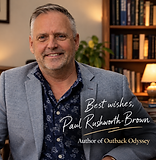
· Author headshots (professional and natural settings)
· Scene-inspired promotional stills
· Social media graphics for event promotion
MEDIA COVERAGE — OUTBACK ODYSSEY
From Australian Story to International Conversation
NATIONAL LAW REVIEW
Human Rights Award Nominee Builds Global Movement Through History and Storytelling
Coverage of Paul Rushworth-Brown's Human Rights Award nomination and the growing international reach of his historical storytelling.
CB HERALD
Australian Historical Novelist Paul Rushworth-Brown Nominated for Author of the Year 2026
Journalist Joseph Wilson examines Rushworth-Brown's approach to historical fiction, describing a body of work characterised by “restraint, moral complexity, and refusal to treat history as simple backdrop or spectacle.”
The article gives particular attention to the allegorical dimension of Outback Odyssey and the way landscape operates within the novel as a moral presence.
RICH BOOKS MAGAZINE
Australia's To Kill a Mockingbird? Why Outback Odyssey Is Sparking Conversations
An examination of the growing comparison between Outback Odyssey and Harper Lee's To Kill a Mockingbird, focusing not on similarities of plot, but on prejudice, moral awakening and the assumptions societies inherit.
THE MOVIE BOARDS
Paul Rushworth-Brown's Outback Odyssey Hailed as Australia's Answer to To Kill a Mockingbird
Coverage examining Outback Odyssey as an Australian story capable of opening a wider conversation about prejudice, identity and national self-examination.
NGAARDA MEDIA
Outback Odyssey: Fiction as Resistance and Remembrance
Coverage placing the novel within a First Nations media context and examining its engagement with history, remembrance and the stories Australia chooses to tell.

ADDITIONAL COVERAGE & SYNDICATION
“A novel that speaks to the soul of a nation.” – Associated Press
Outback Odyssey is already making headlines ahead of its release. From national wire services to literary podcasts and cultural programs, media outlets are praising author Paul Rushworth-Brown for his powerful storytelling and the novel’s relevance to modern Australia.
Feature Articles & Reviews
Associated Press – “New Novel Unmasks Rural Australia’s Mental Health Crisis and the Legacy of Colonisation”
Read article “A story rooted in land, legacy, and the silence between words.”
Movie Press Releases – "After Anzac Day Heckling, Novel Outback Odyssey Emerges as a Timely Call for Understanding, Respect, and Reconciliation"
Read article “Rushworth-Brown has written not just a novel, but a spiritual map of a wounded country.”
The Australian – "Reconciliation Week: New Novel Outback Odyssey Brings the Spirit of Reconciliation to the Page—and Soon, to the Stage" Read article “With a screenplay adaptation complete, this story is ready for its next life—on screen.”
US National Times – “A Journey Etched in Red Earth: Paul Rushworth-Brown’s Outback Odyssey Captivates Early Readers.” Read article Paul Rushworth-Brown delivers a tale that speaks to trauma, land, and the quiet strength of survival.”
Interviews & Broadcast Appearances
Paul Rushworth-Brown has appeared on a range of international radio, television, and literary interview platforms discussing historical fiction, migration history, and the cultural themes explored in Outback Odyssey.
Selected appearances include:
• Moments with Marianne — KMET 1490AM & 98.1 FM (ABC Talk News Radio Affiliate, California, USA)
• PSI TV — International television interview on historical storytelling and Outback Odyssey
• America Tonight with Kate Delaney — U.S. syndicated talk radio
• The Neil Haley Show — U.S. national broadcast interview• Associated Press interviews and international literary coverage
• BBC
Rushworth-Brown is also the host of the international author interview series Down Under Interviews, which features writers from around the world discussing research, craft, and the historical forces behind their work.
ADAPTATION
The screenplay adaptation of Outback Odyssey is complete and is currently being pitched for development.
With its vast Australian landscapes, intimate character relationships and collision of cultures and histories, the story was conceived with a strong visual dimension from the beginning.
The project is open to discussions with producers, development partners and First Nations advisers and collaborators interested in bringing the story to screen with historical and cultural integrity.
“I always saw this story cinematically—from the first time Jimmy stepped off the ship.”
— Paul Rushworth-Brown

The Land (Country) – Country is more than a backdrop in Outback Odyssey. It is a presence.
At first Jimmy sees the outback as empty, hostile and something to be survived. Gradually, through Jarrah and Dhirrari, he begins to understand how little he actually sees.
The landscape carries history, knowledge and memory. It determines where people travel, how they survive and how they understand their place within the world around them.
Jimmy's changing relationship with Country therefore becomes part of his transformation. What he initially sees as emptiness ultimately reveals the limitations of his own understanding.
In Outback Odyssey, knowing a country begins with learning how to see it.

Jimmy Brown – A 17-year-old Yorkshire migrant who comes to Australia through the Big Brother Movement searching for a new life.
Curious, resilient and sometimes naïve, Jimmy arrives carrying assumptions about Australia and its people that experience will gradually challenge. His journey through the outback becomes more than a struggle for survival: it becomes a journey towards understanding, belonging and a very different idea of what it means to know a country.
Jimmy's moral compass is not perfect. It has to be recalibrated. As his understanding changes, his personal journey gradually begins to hold a mirror to Australia itself.

Amanda Olsen – A spirited, forward-thinking young woman caught between her father’s shadow and her own awakening.
Raised in privilege but drawn to justice, Amanda becomes a bridge between two worlds—between settler power and cultural respect, between the past and what could be.
Her growing love for Jimmy is quiet, complex, and transformative. Through their bond, Amanda begins to question the legacy she’s inherited and imagine a different future—not just for herself, but for the land and its people.
Their relationship is not a rescue, but a reckoning—built on trust, hardship, and the possibility of healing.

Jarrah – A respected Elder of the fictional Munarrakalai people and one of the most important influences on Jimmy's transformation.
Calm, observant and deeply connected to Country, Jarrah teaches Jimmy that survival requires more than physical endurance.
Through him, Jimmy begins to understand the importance of listening, respect, knowledge and seeing Country through eyes other than his own.
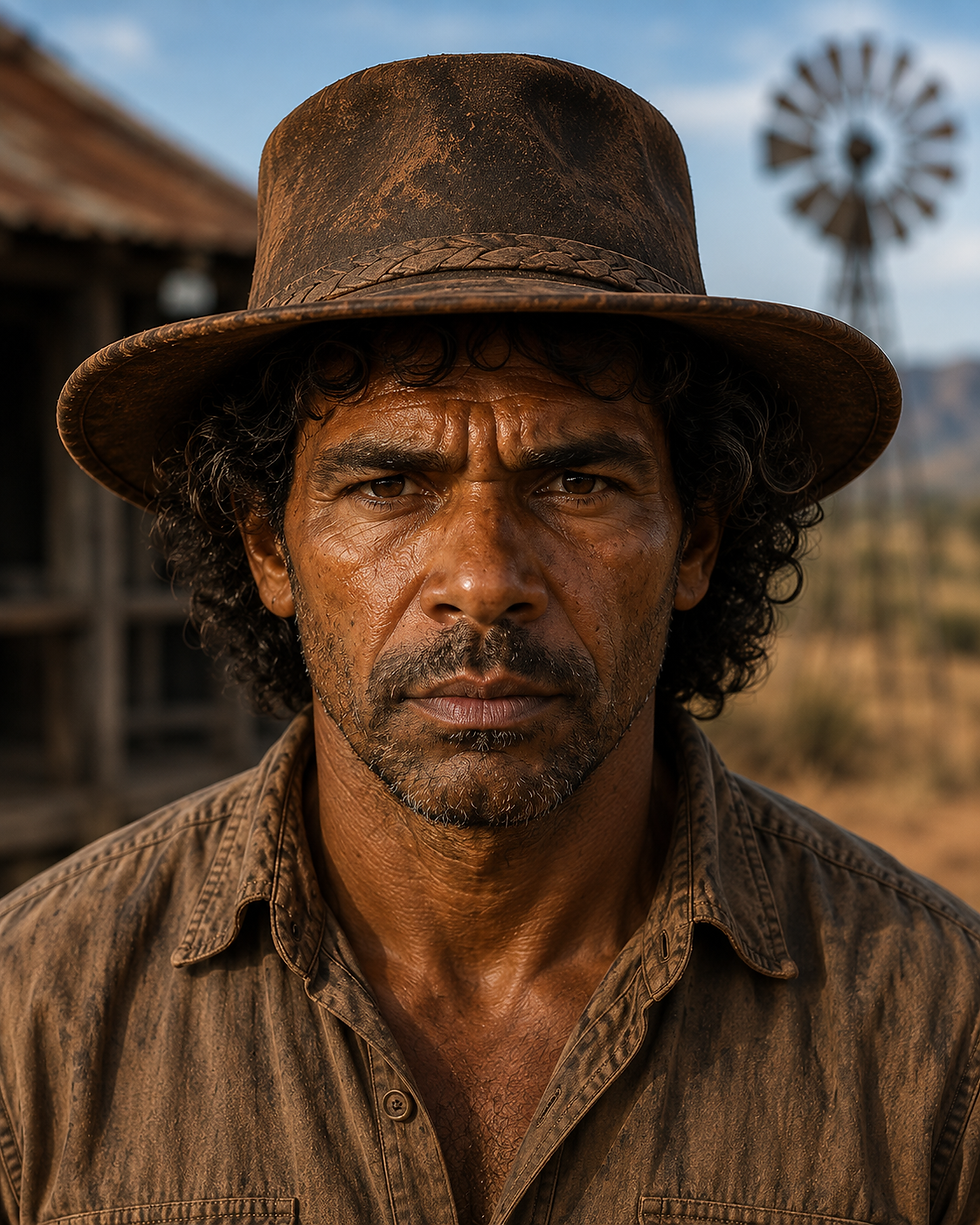
Dhirrari – A senior stockman and mentor whose knowledge of Country, livestock and people has been shaped by a lifetime in the outback.
Quietly confident and highly observant, Dhirrari becomes another important figure in Jimmy's education.
But Dhirrari carries a secret of his own—one that connects him to the Olsen family and reveals that the relationships between those who live on the station are far more complicated than Jimmy initially understands.

Derek Olsen- A powerful station owner accustomed to authority over the land, his family and those who work around him, Derek Olsen is the principal antagonist of Outback Odyssey.
His racism, sense of entitlement and assumptions about those around him reflect attitudes that existed within Australian society and form part of the world Jimmy must learn to understand—and ultimately question.
Derek therefore plays an important role in Jimmy's transformation. As Jimmy witnesses the consequences of prejudice and unquestioned power, he is forced to examine not only Derek's beliefs, but some of the assumptions he himself brought to Australia.
Derek represents an older order built around hierarchy, ownership and attitudes rarely questioned by those who benefited from them. As Jimmy's moral compass is recalibrated, Derek increasingly becomes the counterpoint against which Jimmy must decide what kind of man he wants to become.
Through their conflict, Outback Odyssey asks a larger question: when prejudice is embedded in the world around us, do we accommodate it—or challenge it?

Ngarra - Amanda's adopted mother and a respected Elder of the fictional Munarrakalai people, Ngarra is quiet, observant and deeply respected within her community.
Her knowledge of traditional medicine becomes crucial when Jimmy is badly injured, challenging assumptions about the value of First Nations knowledge. Ngarra doesn't argue against prejudice—she disproves it through what she knows and does.
She is also a keeper of secrets and appears to know considerably more about Wiberg's Gold than she is prepared to reveal.

Suraj - Jimmy's cabin mate aboard the RMS Orion, Suraj quickly becomes far more than a fellow passenger.
Warm, humorous and quietly self-assured, he and Jimmy form an unlikely friendship that grows into something closer to brotherhood during the long voyage to Australia.
When Suraj suddenly disappears during one of the ship's stops, Jimmy refuses to leave without him, revealing just how deeply their friendship has grown.
Suraj becomes an important part of Jimmy's education aboard the Orion—and one of the first people to show him that friendship and belonging can cross boundaries he had barely considered before leaving England.

Mr Mark Olsen - A distinguished older gentleman whom Jimmy meets aboard the RMS Orion, Mr Olsen is well travelled, worldly and fond of a margarita or two.
Mr Olsen becomes Jimmy’s first guide to Australia. Through their conversations he introduces the young Yorkshireman—and the reader—to the country’s history, character and contradictions before Jimmy ever sets foot on Australian soil.
He tells Jimmy about the kangaroo and emu on Australia’s coat of arms: two animals often said to symbolise a nation moving forward because neither readily moves backwards.
But the Australia Mr Olsen describes aboard the Orion and the Australia Jimmy will eventually discover for himself are not always the same.
CULTURAL ACKNOWLEDGEMENT/ INTEGRITY STATEMENT
Outback Odyssey was created with deep respect for the traditional custodians of the land on which this story is set. While fictional, the novel draws upon publicly available ethnographic records and cultural consultation to honour First Nations' people and the wisdom of Country.
We remain open to ongoing collaboration with First Nations advisers during any future stage or screen development.
Additional Resources
The Real Story Behind Outback OdysseyHistorical background, archival photographs, and the migration history that inspired the novel:https://www.paulrushworthbrown.com/the-real-story-behind-outback-odyssey
Author Website https://www.paulrushworthbrown.com
Down Under Interviews (Author Interview Series)YouTube: https://www.youtube.com/@DownUnderInterviews
THE REAL STORY BEHIND OUTBACK ODYSSEY

THE REAL JIMMY BROWN
Outback Odyssey is fiction.
But the journey began with a real young Yorkshireman who crossed the world looking for a new life.
His name was Jimmy Brown.
He was my father.
- Paul Rushworth-Brown

The real Jimmy Brown
Then the Real Story URL


https://authorpaulrushworthbrown.wootick.com/blog/6-australian-novels-you-must-read-before-you-die
Rich Books Magazine has reviewed Outback Odyssey. My father Jimmy Brown left Yorkshire for Australia in the 1950s, and the first part of the novel is his story: the orphanage at Outlane, the Big Brother Movement, and the voyage out on the Orion. From there Jimmy's journey takes him to a sheep station in Gippsland, where he asks the Elders to teach him the land. Read the review in Rich Books Magazine: https://richbooksmagazine.com/article/outback-odyssey-review #OutbackOdyssey #HistoricalFiction #AustralianFiction #BigBrotherMovement #BookReview