





The Story That Refuses to Stay on the Page: Outback Odyssey Media Coverage

Outback Odyssey media coverage is reaching readers across Australia and overseas, with reviews, interviews and features exploring Paul Rushworth-Brown's historical fiction and its themes of migration, Aboriginal culture, reconciliation and belonging.
Outback Odyssey Media Coverage: From Ngaarda Media and CB Herald to Bulletin Magazine UK, Rich Man Magazine and MSN, the book has attracted attention for the questions it raises about Australia's past and the people whose stories deserve to be heard.
Explore the articles, discover what journalists and reviewers are saying, and follow the growing conversation surrounding Outback Odyssey and its journey from the page towards the screen.
When I began writing Outback Odyssey, I wasn't thinking about newspaper headlines or international coverage. I was thinking about my father's journey from Yorkshire to Australia, the country he encountered, and the people whose stories were so often missing from the history I had grown up reading.
That became the starting point for Jimmy Brown's journey.
A young English migrant arrives in post-war Australia believing he knows something about the world. He soon discovers how little he understands about the land, its people and himself. His experiences challenge the assumptions he brought with him, particularly those concerning Aboriginal people and their relationship with Country.
It's been interesting to see which parts of that story have caught the attention of journalists, reviewers and interviewers.
Some have been drawn to the historical background. Others have focused on reconciliation, the book's portrayal of the Australian landscape, or its potential for adaptation to the screen.
As Outback Odyssey continues to attract attention from Australian and international publications, a larger question is beginning to emerge: could this story of migration, prejudice, reconciliation and belonging become one of the most important Australian books of the decade?
That is a judgement for readers to make. But at a time when Australia is still grappling with its history, the conversations this book seeks to encourage are perhaps more relevant than ever.
Explore the reviews, interviews and media features below, and decide for yourself.
Outback Odyssey Media Coverage: A conversation about reconciliation
In CB Herald, Joseph Wilson explored the relationship between storytelling, reconciliation and the stage in Bringing Reconciliation to the Page and Stage: An Executive Q&A on Outback Odyssey.
The conversation looked beyond the book itself to the responsibilities involved in bringing a story like this to a wider audience, particularly when it deals with Australia's colonial past and First Nations experiences.

Read the CB Herald interview:
Ngaarda Media approached the story through a different lens, publishing Outback Odyssey: Fiction as Resistance and Remembrance.
For me, this coverage carries particular significance. Aboriginal perspectives are central to the questions the book raises. Jimmy's journey is not about arriving in Australia and teaching others something. It is about discovering that he has a great deal to learn.

Read the Ngaarda Media article:
Could Outback Odyssey belong on screen?
Across in Britain, Bulletin Magazine UK explored the possibility of bringing the story to the screen.
Its feature, From A Town Like Alice to Outback Odyssey: Why Australia's Great Stories Belong on Screen, placed the book within a wider conversation about Australian storytelling and the enduring appeal of stories set against the country's landscape and history.
The comparison with A Town Like Alice was particularly interesting to me. Both stories involve people arriving in unfamiliar circumstances and being changed by their experiences, although they approach Australian history from different directions.
With a screenplay for Outback Odyssey now completed, this is a conversation I'm keen to continue.

Read the Bulletin Magazine feature:
The book behind the headlines
One of the more personal responses came from Rich Man Magazine, which published a review titled Outback Odyssey Review: The Yorkshire Orphan Who Asked to Be Taught the Land.
That title gets close to something I've always felt was important about Jimmy Brown.
He doesn't arrive in Australia with all the answers. He makes mistakes, misjudges people and gradually begins to question ideas he once accepted without thinking.
His greatest journey isn't simply the distance travelled from Yorkshire to Australia. It's the change that takes place within him.

Read the Rich Man Magazine review:
The family history behind the book also received attention through MSN, in a feature examining how my father's migration from Yorkshire helped inspire Jimmy Brown's fictional journey.
Although Outback Odyssey is a work of fiction, its beginnings are deeply personal. My father's experience gave me a way into a much larger story about migration, displacement and finding somewhere to belong.

Read the MSN feature:
The conversations continue
I also joined Sai Marie for an interview published on The Mind of Sai Marie on Substack.
Interviews offer something different from written reviews. There's room to discuss the decisions behind a story, the research, the characters and the questions that don't always have straightforward answers.
Read the interview:
Recognition and wider distribution
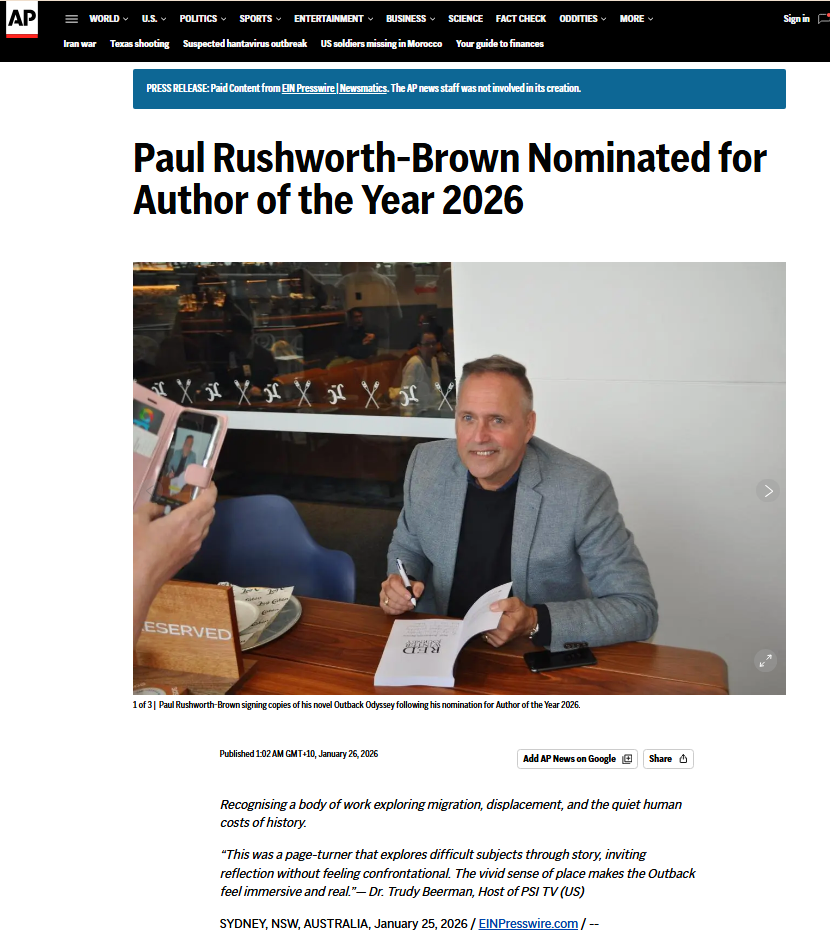
Alongside this editorial coverage, announcements concerning Outback Odyssey and my work have appeared through third-party press-release distribution.
The National Law Review carried an announcement concerning my Human Rights Award nomination and the role of historical storytelling in encouraging discussion about the past.

Global Book Review also republished a press release titled Outback Odyssey Sparks Backlash and a Global Wave of Support, concerning the public response to the book and the difficult subjects it explores.
These two items are press-release republications rather than independent editorial reviews, but they form part of the book's wider public record.
A story that began with one journey
What interests me most about this coverage isn't simply the number of places where Outback Odyssey has appeared.
It's the different conversations the story has opened.
A reviewer in one country sees a young man's struggle to belong. Another publication sees questions about reconciliation. Someone else sees the possibility of a film.
I began with my father's journey to Australia and a question about what happens when a young person encounters a world that challenges everything he has been taught.
That question is still at the heart of Outback Odyssey.
And I'm pleased that readers, reviewers and interviewers are continuing to explore it.
Paul Rushworth-Brown


Comments