.png)

Paul Rushworth-Brown | Australian Historical Novelist, Historian & Educator
Australian historical novelist • Historian • Interviewer • Educator
Paul Rushworth-Brown is an Australian historical novelist, historian, interviewer, and educator whose work explores the human cost of history through award-winning novels, historical research, international interviews, and free educational resources.
Creator of The Human Cost of History, Paul brings the past to life through stories of ordinary people facing extraordinary moments.
Featured on international television, radio, podcasts, and literary media across Australia, the United States, and the



Read the free serialized historical mystery
Click Above
Explore Paul's Historical Fiction




Chronicle IX-The Search
The knock had come.
Now there was no turning back.
For years, John Hargreaves and his family had lived quietly on the edge of Haworth, keeping their faith hidden from neighbours, parish officials, and the Crown.
Silence had kept them safe.
Secrecy had kept them alive.
But all it took was one accusation, one informer, or one careless mistake for everything to unravel.
As the King's men crossed the threshold of the cottage, fear settled over the household like a winter fog.
Every chest.
Every cupboard.
Every loose floorboard.
Every forgotten possession.
Became a threat.
Because the search was never really about what the constables hoped to find.
It was about what the Hargreaves family feared they might.
And before the day was over, someone would discover something they were never meant to see.
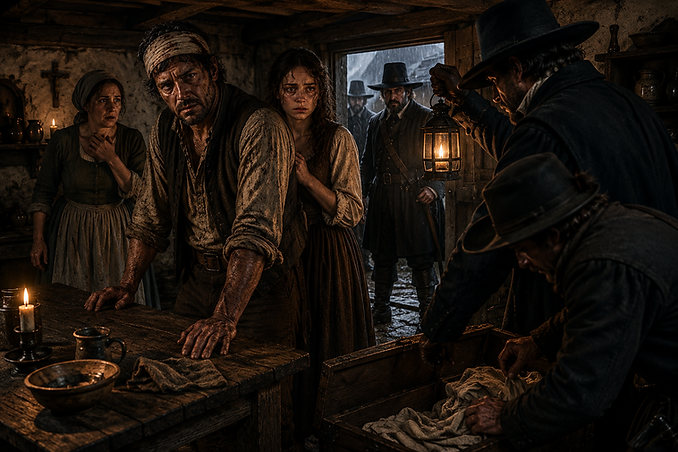
The words struck the cottage like a clap of thunder.
"Open in the King's name."
John Hargreaves stood motionless, his hand resting upon the latch.
Behind him, Margaret's face drained of colour. Her hand instinctively found the small wooden cross hidden beneath her dress. Above them, Agnes stood frozen on the stairs.
The knock came again.
Harder.
More impatient.
"Open up!"
John swallowed.
He knew too well what men like these could do.
Years earlier, when he still lived near Keighley, a neighbour had been accused of harbouring a priest. At first, nobody believed it. Then came the search. Men carrying lanterns and warrants entered his cottage and turned the place upside down. Chests were broken open. Floorboards lifted. Bedding slashed. They found little, but it scarcely mattered.
The fines followed.
Then the seizure of goods.
The man's cow was taken first. Then his land.
Before long he was carried away to York Gaol in chains.
Nobody in the district ever saw him again.
Some said he died there.
Others whispered he had been questioned until his body gave out.
Whether any of it was true scarcely mattered.
The lesson travelled quickly through the villages.
Keep your faith.
Keep your silence.
Trust no one.
John lifted the latch.
The door swung open.
Two constables entered carrying lanterns, their cloaks wet with mist. Behind them stood a parish official John recognised from Haworth.
The man looked around the cottage slowly.
"John Hargreaves?"
"Aye."
"We have business here."
John forced himself to meet the man's gaze.
"What sort of business?"
"The Steward's business."
The official stepped forward without invitation.
"Search the house."
The words struck Margaret harder than any blow.
One constable immediately began opening chests and cupboards. The other moved towards the stairs.
Agnes.
John felt his stomach tighten.
The constable climbed slowly, lantern raised before him.
Each footstep echoed through the cottage.
Margaret lowered her eyes and silently moved her lips in prayer.
John wished she wouldn't.
Prayers had a habit of becoming evidence.
The constable disappeared from sight.
The family listened.
A floorboard creaked.
A chest lid opened.
Something scraped across timber.
Then silence.
Too much silence.
John's palms were slick with sweat.
He remembered another story whispered years before in the King's Arms. A recusant family near Skipton had hidden a prayer book beneath loose floorboards. They thought themselves safe.
They were wrong.
The searchers found it.
By winter they had lost their livestock.
By spring they had lost their home.
The official wandered slowly around the room, studying every corner.
The crucifix above the hearth had long since been removed.
The rosary beads hidden.
The prayer books buried.
Yet John still felt exposed.
As though every secret the family had ever carried had somehow been written upon the walls.
A heavy footstep sounded overhead.
Then another.
The constable appeared at the top of the stairs.
He looked directly at the official.
The family held its breath.
"I've found something."
Margaret gasped.
John felt the blood drain from his face.
Slowly, the constable began descending the stairs.
In his hand he carried a small object wrapped in cloth.
John stared at it.
He did not know what the constable had found.
Margaret gripped the edge of the table so tightly her knuckles turned white.
The constable handed the bundle to the parish official.
"What is it?" asked John.
The official frowned.
It wasn't money.
Nor a weapon.
He slowly unwrapped the cloth.
A small leather-bound book lay inside.
The pages were worn from use.
He opened it.
Several passages had been marked.
A pressed flower lay between two pages.
On the inside cover was written a single name.
Robert Hargreaves.
Nobody spoke.
The official slowly closed the book.
The cottage felt smaller somehow.
Colder.
At length the official looked up.
"I think the steward will wish to see this."
Margaret gasped.
John felt the blood drain from his face.
The constables gathered their things and turned towards the door.
The prayer book remained in the official's hand.
Years of silence.
Years of caution.
Years of hiding.
And now their secret was walking out through the door.
And for the first time in many years, John Hargreaves feared that before the sun set, everything his family had fought to protect might be lost.
The cottage remained silent long after the constables had gone.
Nobody moved.
Nobody spoke.
The sound of their footsteps slowly faded down the lane.
Margaret sat heavily upon the stool beside the hearth.
John remained standing near the door.
Agnes stared at the empty space where the prayer book had been.
At length she spoke.
"I didn't think it mattered."
Her voice was barely above a whisper.
John turned towards her.
"What didn't matter?"
"The book."
Margaret looked up sharply.
"Agnes."
The girl lowered her eyes.
"I only kept flowers in it."
John frowned.
"What?"
"The flowers from the meadow above Oxenhope. The blue ones."
Margaret closed her eyes.
"Dear God."
"I wasn't reading it," Agnes said quickly. "Most of it is in Latin. I can barely make sense of it."
She looked between her parents.
"It belonged to Grandfather."
Nobody answered.
"The flowers kept falling from between the pages, so I left them there."
John sat slowly upon the bench.
Years of caution.
Years of hiding.
And now a book forgotten amongst a young girl's belongings sat upon the steward's table.
Margaret began to cry.
"It starts again," she whispered.
John stared into the fire, "It never truly ended."
A prayer book.
His father's prayer book.
In another place it might have been nothing more than an old family keepsake.
Here, it could cost them everything.
Enough to lose a livelihood.
Enough to lose a home.
Enough to remind people that some secrets were never truly buried.
That evening, little was said.
That evening, little was said.
The family ate their supper in silence before retiring early.
Sleep came to none of them easily.
John lay awake long after the others had settled, listening to the wind against the cottage walls and wondering what the steward intended to do.
Shortly after sunrise the following morning, a knock sounded at the door.
John opened it to find one of the manor boys standing outside.
The lad removed his cap nervously.
"Message from the steward."
John felt his stomach tighten.
The boy handed him a folded piece of parchment.
"Thee and Agnes are to attend Haworth Manor before noon."
John unfolded the message and read it silently.
There was no explanation.
None was needed.
He folded the parchment carefully.
Before noon, he and Agnes would stand before the steward.
The waiting was over.
-IX-

From Readers
Readers and reviewers have described the novel as immersive, atmospheric, and vividly grounded in the harsh realities of 17th-century Yorkshire.