





Henry VIII's Triumph in Yorkshire: A Story of Rebellion, Subjugation and Skulduggery

Updated: Jul 25

Henry VIII's Triumph in Yorkshire: A Story of Rebellion, Subjugation and Skulduggery
When it comes to Henry VIII's achievements, his conquest of Yorkshire remains a lesser-known tale. Unlike traditional battles, this victory was achieved through more clandestine methods: fear and impoverishment. For centuries, Yorkshire, had been thorns in the sides of English kings. Despite being smaller and less affluent than the South, Yorkshire's heritage of independence, rooted in its Scandinavian roots, produced a population of tough and hardy fighters. These men and women proved invaluable in defending against Scottish invaders and were a force to be reckoned with in times of conflict, often rallying under their own northern lords such as the Percys, the Nevilles, and the Scropes.
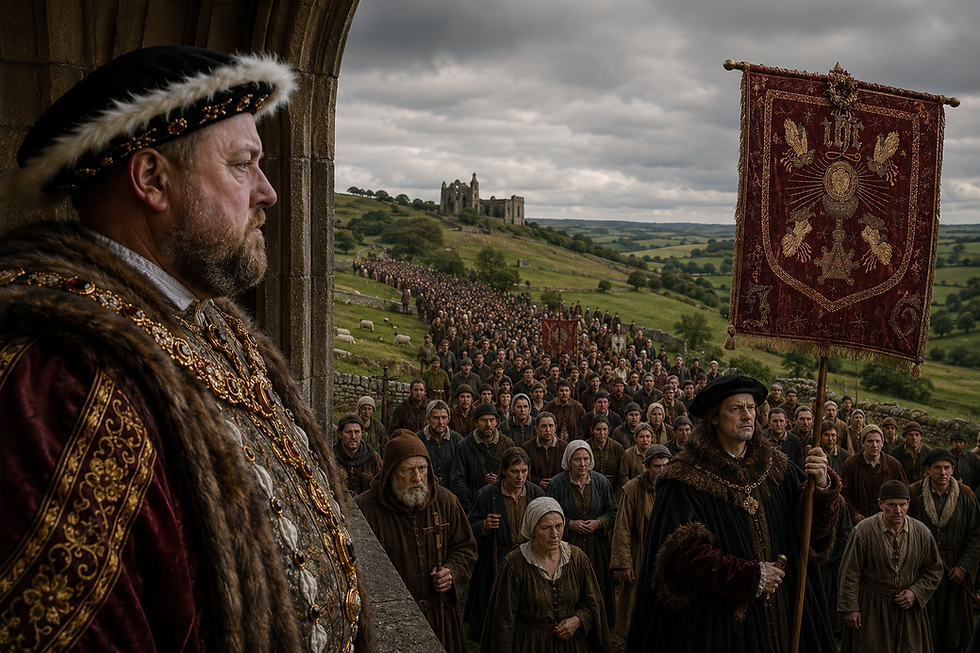
Henry VIII aimed to centralise government in London, establishing himself as the sole authority. He preferred to keep the powerful landholders close, mimicking the practices of a mafia boss. He surrounded himself with lesser men who relied solely on his favour for their wealth and status. The closure of monasteries presented an opportunity for him to build loyalty among ambitious individuals.

Step into the lesser known chapter of Henry VIII's reign, where the fate of Yorkshire hung in the balance. Fuelled by a combination of religious discontent and a sense of diminishing prestige in a court brimming with low-born Southerners like Cromwell, these noble figures sought to incite change and protect their way of life. Together with countless ordinary northern folk, they embarked on a peaceful protest march towards London, known as the Pilgrimage of Grace. While their intentions were peaceful, the sheer numbers involved posed a formidable threat to the king.
The Yorkshire lords and commoners, united in their cause, found themselves at Doncaster, the halfway point to their intended destination. There, they were met with persuasive words from the crown, coaxing them to disperse and return home. Little did they know that this marked the beginning of their downfall. In the months that followed, those who had participated in the pilgrimage, both nobles and commoners alike, were relentlessly hunted down. The punishment for their defiance was severe, with some members of ancient northern families meeting gruesome fates through hanging, drawing, and quartering.
The aftermath of the rebellion saw fines and burdensome taxes imposed, crippling the previously well-off citizens of Yorkshire. With their wealth drained, they remained humbled by poverty and faced with the harsh reality of their defeat.
Henry VIII's promises proved short-lived. Following further outbreaks of unrest in the North, the King abandoned his earlier assurances. Robert Aske was arrested, convicted of treason, and on 12 July 1537 was executed at Clifford's Tower in York. Rather than a simple hanging, he was suspended in chains, his body left on public display as a warning to anyone who might contemplate further rebellion.
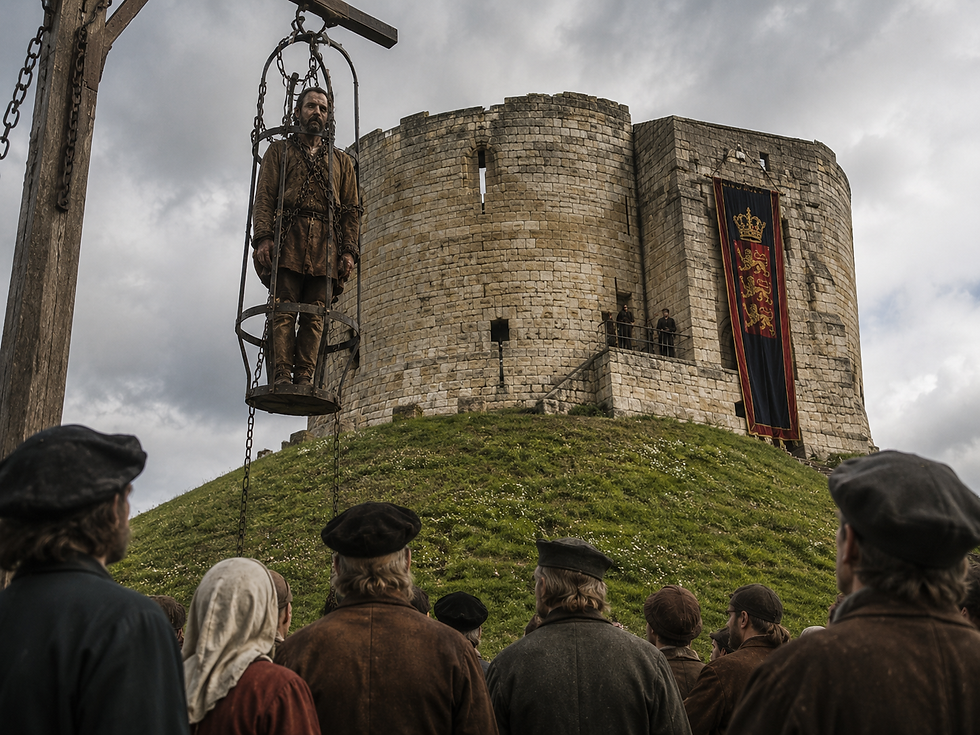
By ordering prominent Yorkshire rebels and the five Cockermouth men to be displayed in this way, Henry was waging psychological warfare against both the dead and the living. In sixteenth-century England, most people believed that a proper Christian burial was essential. The body was expected to be buried promptly, accompanied by the rites of the Church, allowing the soul to rest in peace.
Gibbeting deliberately denied that final act of dignity. After execution, the corpse was enclosed within an iron cage or wrapped in heavy chains and suspended high above the ground, often on a rotating gibbet where wind, weather and scavenging birds slowly consumed the remains. In some cases, the bodies were coated in tar to delay decomposition, ensuring that the warning remained visible for months or even years.
For Henry VIII, the punishment extended beyond death. Every traveller who passed the gibbet was reminded of the consequences of defying the Crown, while grieving families were denied the comfort of burying their loved ones according to Christian tradition. It was punishment designed not only to execute the rebel, but to break the spirit of an entire community.
________________________________________________________________________________
History isn't only about kings and battles. It is also about the ordinary men, women and children whose lives were shaped by the world around them.
If you enjoyed this article, explore more true stories from Tudor and Stuart England, discover the research behind my historical fiction, or follow the free serial, The Thomas Rushworth Chronicles.
Books& Literature
Continue exploring here:https://www.paulrushworthbrown.com/stories
About the Author

Paul Rushworth-Brown is an Australian historical novelist, researcher and creator of The Human Cost of History. Through carefully researched articles and historical fiction, he explores the forgotten lives of ordinary people whose experiences have often been overlooked by history.
His work spans Tudor and Stuart England, colonial Australia and the people who lived through some of history's most turbulent periods. He is also the author of The Thomas Rushworth Chronicles, a free historical serial set in Yorkshire between 1590 and 1603.


Comments