.png)





Marriage and Sexuality in Early Modern England

Updated: Aug 1

Forbidden love. Family expectations. Reputation hanging by a thread.

Marriage in early modern England was never simply about two people choosing each other. Love, desire, inheritance, religion, and social standing shaped every relationship. A whispered rumour could destroy a reputation. A family's approval could determine a future. For ordinary men and women, the heart often found itself at odds with the world around it.
Behind the myths of child brides and arranged marriages lies a far more human story—one of courtship, obligation, sexuality, family pressure, and consequence.
Marriage and Sexuality in Early Modern England sometimes involvbed forbidden love. Family expectations. Reputation hanging by a thread.
Marriage in early modern England was never simply a matter of two people choosing each other. Love, desire, family interests, religious beliefs, and community expectations all played a role in determining who married whom and when.
The religious divisions of the period often complicated matters further. Following the English Reformation, marriage was expected to take place under the authority of the Church of England. For recusant Catholic families, questions of faith, loyalty, and religious identity could create tensions that extended far beyond the couple themselves. A marriage might unite two people, but it could also expose divisions between families, communities, and beliefs.
These pressures are reflected throughout The Thomas Rushworth Chronicles. When Thomas Rushworth and Agnes finally marry, their wedding night is far from a private affair. The vicar blesses the marital bed, neighbours accompany the couple into their cottage, relatives prepare the bedchamber, and witnesses remain nearby to ensure the marriage is properly consummated. What modern readers might regard as an intimate moment was, for many ordinary people, a matter of community importance, reputation, and social legitimacy.
Although canon law allowed girls to marry at twelve and boys at fourteen, most ordinary people married much later. For peasants and labouring families, marriage often depended on practical concerns such as employment, financial security, and the ability to establish a household.
Childhood itself was understood very differently from today. Once young people were considered capable of understanding their actions and responsibilities, they were expected to contribute to the adult world.
The choices surrounding courtship, marriage, and sexuality did not exist in private. They were shaped by family pressure, church authority, local customs, and the watchful eyes of neighbours. For ordinary men and women, matters of the heart were rarely free from social consequence.
Marriage and Sexuality in Early Modern England
Given its social significance, marriage was regarded as a matter that concerned the wider community, not simply the couple themselves. One popular misconception is that young women were routinely forced into marriages with much older men they barely knew. While marriages were certainly influenced by family expectations, social standing, and economic realities, most ordinary couples still exercised some degree of choice and were expected to seek the approval of parents and relatives rather than submit to arrangements made entirely on their behalf.
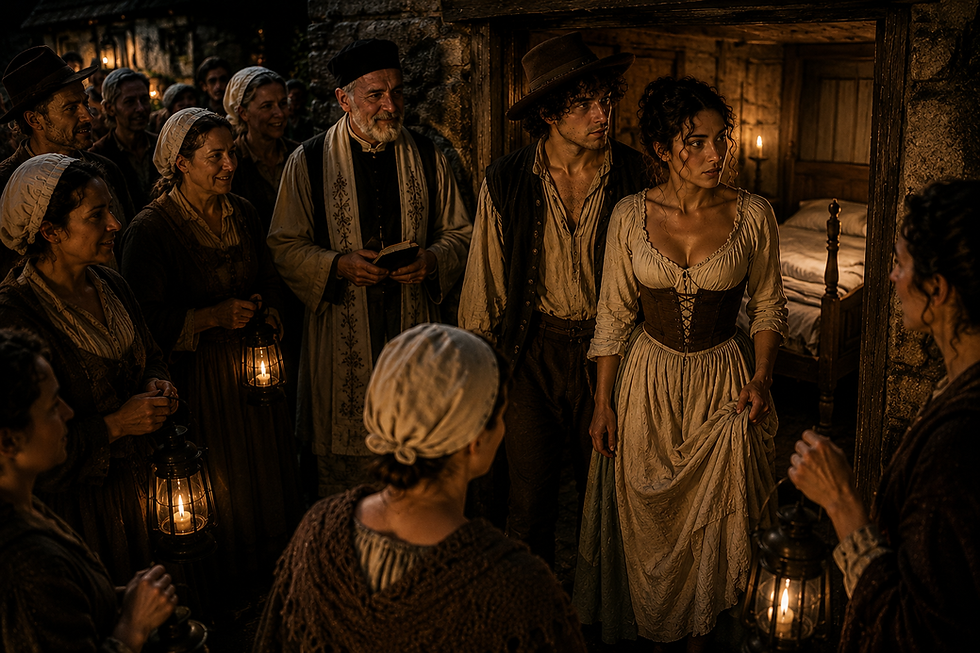
Marriage was also far less private than modern readers might imagine. In The Thomas Rushworth Chronicles, when Thomas Rushworth and Agnes finally marry, their wedding night unfolds under the watchful eyes of family, neighbours, and the church. The newlyweds are escorted to their cottage by members of the community, the marital bed is prepared and blessed, and relatives remain nearby to ensure the marriage is properly consummated. Even after the couple are left alone, Cousin Mary lingers outside the cottage door, listening for signs that the union has been successfully completed.

Such customs may seem intrusive today, but they reflected the importance attached to marriage in early modern society. A marriage was not simply the union of two individuals. It involved families, inheritance, reputation, religion, and the stability of the community itself. What happened behind the bed curtains was often considered a matter of public interest as much as private affection.
There were several criteria which decided whether a match was ‘appropriate’. It was recommended that the couple should be of similar age, background, financial circumstances, and religious beliefs. The husband and wife should like and respect each other—even love each other—but they should beware of mere sexual fascination and look for other qualities such as whether they could keep house and cook. Most importantly, a woman should be a virgin on her wedding night and infidelity was punishable with death. However, records do indicate that between 10% and 30% of women were pregnant before they were married.
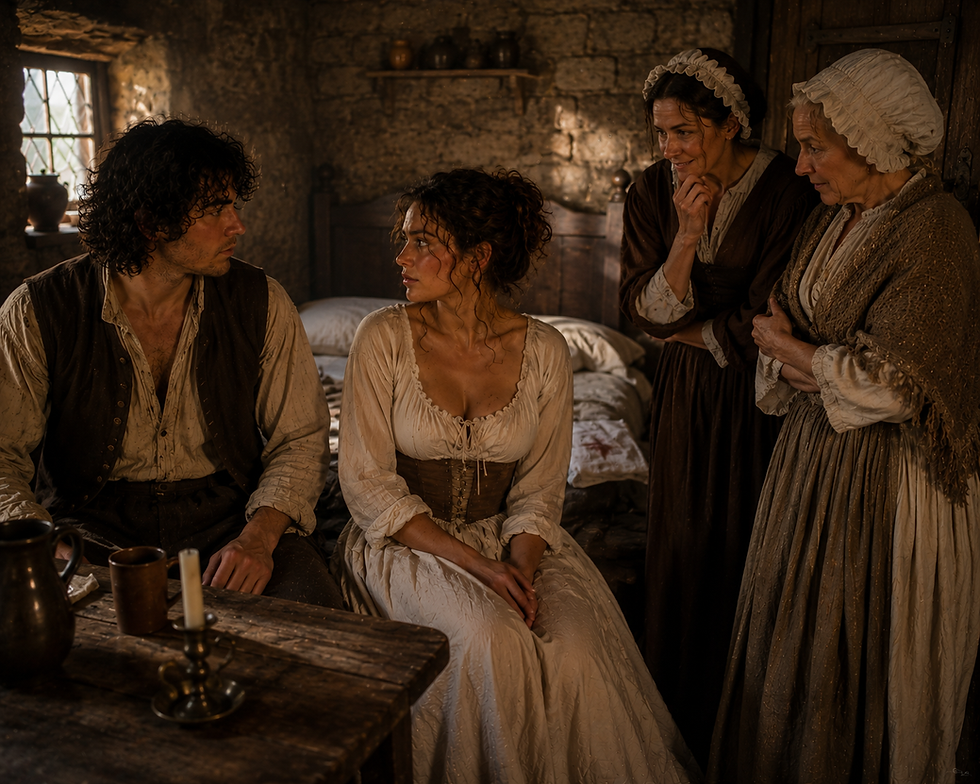
On the night of the wedding when the wedding had to be consummated and the wife would have sex with her husband for the first time, there also existed laws. The church acknowledged that a woman was required as part of God's play to go forth and multiply. A woman shouldn't, however, enjoy sexual relations. Married life was perceived as a parallel of Christ’s bond with his church, so passionate love between husband and wife was regarded as undesirable. Sex in the missionary position was the only form of sex deemed acceptable and natural. All other positions and sexual acts were considered sodomy; the charge of sodomy was so serious that it would have been tried in the secular court and possibly been subject to a death sentence.
The Wedding Night Was Not Always Private
The Church taught that the purpose of sex is reproduction and sex was not permitted on a Wednesday, or a Friday, on a Sunday, or Saturday, on any of the 60 church feast days, during lent, during Advent, during Whitsun week, Easter week, while a woman is menstruating, while a woman is pregnant, while a woman is breastfeeding, within the walls of a church, during daylight, if she is completely naked, for the eight days leading up her husband taking the Eucharist or if the couple were related.
Enjoyed this article?
If you're fascinated by the lives of ordinary people throughout history, explore The Thomas Rushworth Chronicles, read Outback Odyssey, or watch interviews with leading historians on The Human Cost of History.
From History to Story
The pressures explored here — inheritance, obligation, silence, and control — shaped the lives of ordinary people far beyond this specific place and time.
These same forces underpin the worlds I explore in my novels, where history is not a backdrop but a lived condition, shaping families long after the moment has passed.
These themes are explored fictionally in The Thomas Rushworth Chronicles, a story shaped by social constraint, reputation, and the quiet consequences of inherited power.
__________________________________________________________________________________
Paul Rushworth-Brown
Paul Rushworth-Brown is the author of four historically grounded novels exploring how ordinary people live inside extraordinary circumstances: Skulduggery, Red Winter Journey, Dream of Courage, and Outback Odyssey.


The rain falls hard across the moors. Rumours move faster than truth. And beneath the authority of Haworth Manor, ordinary lives begin to disappear into silence.
The Thomas Rushworth Chronicles is a dark historical mystery series set in the dangerous world of early seventeenth-century Yorkshire — a land of torchlit roads, hidden loyalties, manor intrigue, recusant secrets, and violence waiting beneath everyday life.
At the centre stands Thomas Rushworth, a young man drawn into events far larger than himself after whispers of treason, disappearances, and forbidden alliances begin spreading through the villages surrounding Haworth. What begins as survival soon becomes something far more dangerous as the lines between loyalty, fear, and betrayal begin to collapse.
Here, history is not a backdrop.
It is a force pressing down on every decision.
As riders arrive in the night and suspicion spreads from taverns to manor halls, families are forced to choose between obedience and survival. Every secret carries a cost. Every silence hides a danger. And every road across the Yorkshire moors leads deeper into a world where ordinary people are trapped inside history.
For readers of gritty historical suspense, atmospheric mystery, and immersive historical noir, The Thomas Rushworth Chronicles delivers a serialized world of mud, firelight, deception, and human consequence — where the past feels disturbingly alive.

Some lives pass through history without leaving a trace.
The Lost Voices is a powerful work of historical fiction that brings to light the forgotten lives history rarely records — not kings, generals, or men of power, but ordinary people forced to survive inside systems far greater than themselves.
Set against the harsh realities of a rigid social order, the novel follows lives shaped by fear, silence, loyalty, and endurance. In a world where truth can be dangerous and survival often depends on what remains unspoken, every decision carries consequence.
As tensions deepen and personal loyalties begin to fracture, the characters are drawn into struggles they never asked to inherit — confronting authority, loss, class division, and the quiet emotional cost of simply trying to endure.
The Lost Voices explores how history is often built upon lives that were never formally remembered. The unrecorded. The overlooked. The people whose stories disappeared beneath power, custom, and time itself.
This is not a story about heroes standing above history.
It is about ordinary people trapped inside it.
Atmospheric, emotionally immersive, and deeply human, The Lost Voices is a historical novel about survival, silence, and the fragile traces people leave behind when the world refuses to remember them.

Outback Odyssey is a historically grounded novel set in post-war Australia — a harsh and unfamiliar land where survival depends not only on endurance, but on the willingness to change.
When a young Englishman arrives in the Australian outback carrying expectations shaped by another world, he quickly discovers that the land does not bend easily to outsiders. The isolation is immense. The rules are unspoken. And the people who survive there have been shaped by pressures he barely understands.
As he is drawn deeper into station life, buried tensions, hidden loyalties, and cultural divides begin to challenge everything he once believed about identity, belonging, and strength. To endure, he must adapt — not only to the brutal realities of the outback itself, but to the emotional and moral complexities of a country still wrestling with the consequences of its own history.
Outback Odyssey is not a story about conquering the land.
It is about what the land demands in return.
Atmospheric, emotionally immersive, and grounded in the human cost of history, the novel explores how ordinary people are transformed when survival forces them to confront who they truly are.

Skulduggery is a dark and atmospheric historical mystery set in the dangerous world of post-Reformation Yorkshire, where fear, suspicion, and hidden loyalties shape the lives of ordinary people struggling to survive.
When rumours, robberies, and unexplained violence begin spreading across the villages surrounding Haworth, one family becomes entangled in a web of deception far beyond their control. Beneath the authority of manor houses and the shadow of religious division, secrets travel quietly through taverns, muddy roads, and torchlit nights — and asking the wrong question can be deadly.
As tensions rise, alliances fracture and survival becomes increasingly uncertain. Every conversation hides another motive. Every act of loyalty carries risk. And every step deeper into the mystery pulls the family closer to forces capable of destroying them.
Skulduggery is not a story about heroes standing above history.
It is about ordinary people trying to survive inside it.
Atmospheric, immersive, and filled with twists, hidden motives, and historical intrigue, Skulduggery blends gritty realism with suspense in a world where fear travels faster than truth and danger rarely announces itself openly.

Red Winter Journey is a powerful historical novel set during the chaos and brutality of the English Civil War, where ordinary lives are torn apart by forces far beyond their control.
As England descends into violence and uncertainty, loyalties are tested between family, faith, and survival. What begins as a young boy’s journey through a fractured country soon becomes a deeply human story about endurance, identity, sacrifice, and the emotional cost of history itself.
Amid bitter winters, ruined villages, and the constant threat of war, a mother fights to protect her son while he is forced to confront a world that demands he grow up far too quickly. The conflict surrounding them is not experienced through kings or generals, but through the fear, loss, hunger, and impossible decisions faced by ordinary people caught in its path.
Red Winter Journey is not a romanticized tale of war.
It is a story about what war does to people.
Atmospheric, emotionally immersive, and grounded in historical realism, the novel explores how survival can reshape loyalty, innocence, and the bonds between families when history leaves no safe place to hide.

Dream of Courage is a sweeping historical novel set during the turbulent Restoration era, where old loyalties are collapsing and ordinary people are forced to navigate a world changing around them.
For the Rushworth family, survival has never been simple. But when ambition, hidden secrets, and dangerous enemies begin closing in, Robert Rushworth is drawn into a journey that will test not only his courage, but the very person he is becoming. Pursued by menacing figures and haunted by the consequences of decisions made under pressure, he must navigate a landscape where trust is fragile and danger often hides behind familiar faces.
Against the windswept moors and villages of Yorkshire, love, loyalty, and survival collide in a society still scarred by political upheaval and social division. The choices Robert makes will shape not only his future, but the lives of those bound to him by family, sacrifice, and fear.
Dream of Courage is not simply a story about adventure.
It is about what history demands from people trying to endure it.
Atmospheric, emotionally driven, and grounded in the harsh realities of rural English life, the novel explores identity, resilience, and the human cost of survival in a world where history reaches into every home, every relationship, and every act of courage.
Continue Exploring the Human Cost of History
Some stories challenge the way nations remember themselves.

Others force us to confront the voices history tried to leave outside the room.
Watch more long-form author conversations exploring history, memory, power, and the lives often overlooked by official narratives.


If you enjoy conversations about history, storytelling, survival, and the human cost behind historical events, explore Down Under Interviews on YouTube. The stories continue long after the interview ends.
YouTube:https://www.youtube.com/@DownUnderInterviews
The Thomas Rushworth Chronicles:https://www.paulrushworthbrown.com/chronicles