
Chronicle IX
The Kings Arms alehouse had long faded behind him, but the danger of the night still followed John Hargreaves across the muddy Yorkshire lanes.
The winnings were gone.
So too were the men who had struck him down beside the road and left him bleeding beneath the cold morning mist.
Most folk would have passed by and thanked God it was not their burden to carry.
Others would have feared bringing a wounded stranger through the cattle door and into the fragile safety of their home.
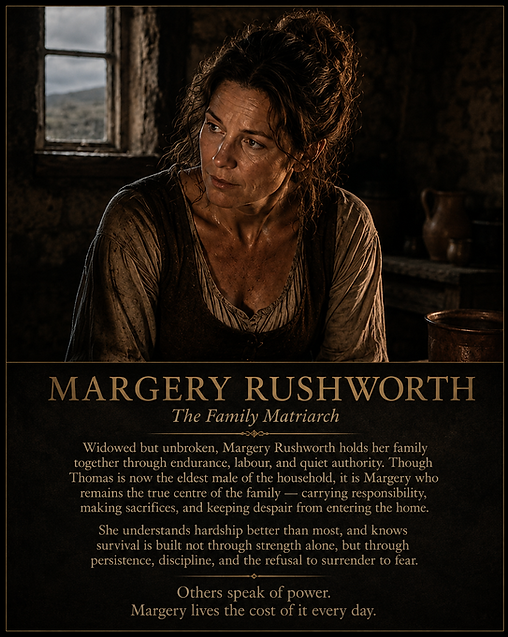
But the Rushworth family had done otherwise.
They had given him warmth, ale, and a place beside the hearth while the pain slowly drained from his battered body.
Yet kindness carried its own dangers in seventeenth-century Yorkshire.
Because John Hargreaves carried more than a head wound back into Haworth.
He carried secrets.
Secrets of hidden faith, quiet persecution, and the dangerous silence required of Catholic families living beneath the rule of the Crown.
While fear lingered inside John Hargreaves’ cottage on Moorehouse Lane, the business of Haworth Manor continued as it always had.
Thomas and William walked the mile toward the manor to borrow two oxen and the suhl in exchange for a single chicken, knowing survival in Yorkshire depended as much upon obedience as labour.
The lord demanded dues.
The steward demanded silence.
And ordinary families learned quickly how dangerous it could be to ask questions about matters beyond their station.
But Haworth Manor carried secrets of its own.
Because the strangers from the Kings Arms had not yet left the village.
Behind the polished stone walls, gravel carriageways, and carefully tended gardens of the manor house, darker business was already beginning to unfold.
Thomas and William walked the muddy road toward Haworth Manor beneath a pale Yorkshire sky.
The suhl rattled behind them while the oxen snorted clouds of steam into the morning air. Gravel crunched beneath their foot wrappings as the manor slowly emerged through the drifting mist beyond the fields.
The manor grounds always unsettled Thomas.
The crushed stone carriageways.
The carefully tended gardens.
The smell of roses growing where poor families struggled simply to keep bread upon the table.
Servants crossed the yard carrying baskets while labourers moved between the barns, stables, and kitchens tending to the lord’s endless business. Even the horses looked better fed than many villagers living beyond the manor walls.
The reeve waited near the outbuildings balancing a ledger beneath one arm.
‘This all thee brought?’ he muttered, lifting the chicken by its legs. ‘Lord’ll be wanting more than that fer use o’ the oxen.’
‘It’s all we have this week,’ Thomas replied carefully.
The reeve grumbled beneath his breath while inspecting the bird.
‘Debts pile quicker than hens lay eggs round here.’
Nearby, villagers came and went returning borrowed tools and completing work owed to the manor.
Young Jonathon carried back an axe from the forest while James hurried away after tending the lord’s upper field before another task could be forced upon him.
‘And Thomas,’ the reeve added quietly, ‘I hear thy family still owes funeral dues from thy father’s passing.’
Thomas lowered his eyes.
‘We’ll pay when we can.’
‘See that ya do. Steward’s in no kindly mood lately.’
Thomas said nothing.
He had learned quickly that silence was often safer near men who carried the lord’s authority.
‘What work’s wanted this week?’ he asked instead.
‘Dry bap wall on old Smithe hide,’ replied the reeve impatiently. ‘Lord wants more pasture fenced before summer.’
Thomas frowned.
‘Another pasture? Soon there’ll be more sheep than folk.’
The reeve shot him a sharp warning glance.
‘Careful who hears thee speak like that.’
Thomas looked away toward the manor gardens.
That was when he noticed them.
The two strangers from the Kings Arms.
Both stood near the steward dressed far finer than ordinary villagers. Their hose remained clean despite the roads, swords hung neatly from polished belts, and their manner carried the confidence of men accustomed to authority rather than labour.
The man with the eyepatch accepted a small leather purse from the steward while the other watched the yard carefully beneath the shadow of his broad hat.
‘How long will you be staying?’ asked the steward.
‘As long as it takes,’ replied the eyepatch man calmly.
Something about the exchange unsettled Thomas.
The steward noticed him watching.
His pleasant expression vanished immediately.
William lowered his head and whispered nervously, ‘Brother… stop starin’.’
Too late.
The steward was already walking toward them.
Thomas removed his hat respectfully.
William did the same.
The steward stopped close enough for Thomas to smell the ale lingering upon his breath.
‘Ahh, young Rushworth,’ he said smoothly. ‘Thee seems mighty interested in my companions.’
‘No sir,’ Thomas replied quickly. ‘Only admiring the manor gardens.’
The steward smiled faintly.
But there was no warmth in it.
‘Aye?’
Thomas nodded cautiously.
For a moment the steward simply studied him.
Then he stepped closer.
‘Young Thomas,’ he whispered softly, ‘thee should remember how fortunate thy family is ta remain upon Lord Birkhead’s land.’
Thomas felt his stomach tighten.
‘Yes, your grace.’
‘Good.’
The steward’s eyes hardened.
‘Then keep thy nose out of business that does not concern thee.’
Silence settled heavily between them.
Behind the steward, servants crossed the yard while somewhere inside the manor hall laughter echoed faintly through an open window.
The steward adjusted his gloves.
‘Would hate ta see thy poor mother cast out from her cottage over unfortunate misunderstandings.’
Thomas kept his eyes lowered.
‘Yes, your grace.’
Satisfied, the steward turned and strode back toward the manor.
William exhaled shakily once he was gone.
‘Christ,’ he muttered. ‘What were all that about?’
Thomas watched the strangers disappear beside the steward through the manor doorway.
Then he looked down at the mud covering his own foot wrappings.
‘Nothing good,’ he said quietly.
As the brothers led the oxen away from Haworth Manor, Thomas glanced back one final time.
The steward and the strangers had vanished behind the stone walls.
But he could not shake the feeling that whatever business had brought those men to Haworth…
had not yet finished.
-IX-
From Readers
Readers and reviewers have described the novel as immersive, atmospheric, and vividly grounded in the harsh realities of 17th-century Yorkshire.